
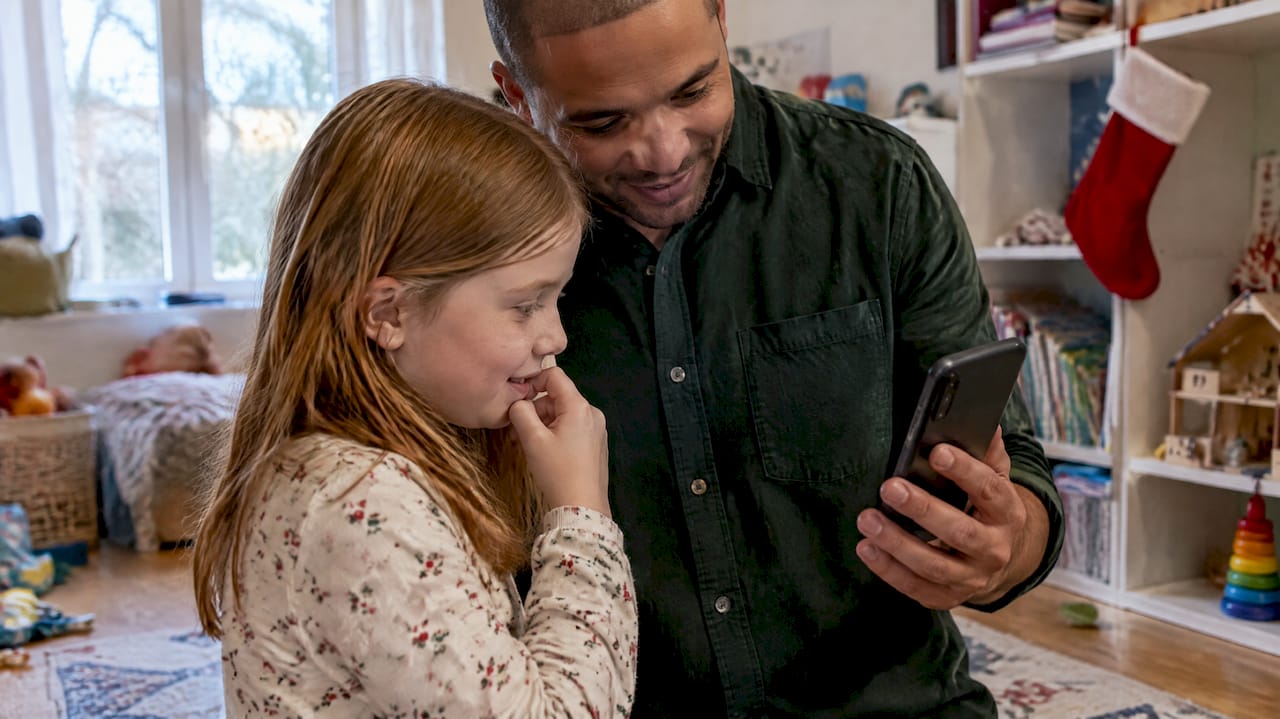
The best text messages from Santa are the ones where he answers back. A child who types “I got a new bike” and gets a reply that mentions the bike, in their own language, believes in Santa a little harder that night. That is what Chat with Santa on WhatsApp is built for: kids message Santa, he texts back, sends voice notes and remembers what they told him. It’s a $9 one-time purchase.
This guide is for parents, grandparents, aunts, uncles and godparents of children roughly 3 to 10. It covers what makes a Santa text believable, what to write, how to keep your child’s information safe and how to turn one message into a memory the whole family shares.
TL;DR
- A Santa text feels real when it has three things: your child’s name, one specific thing Santa noticed and a wish for the year ahead.
- Two-way chat beats one-way broadcasts: the child writes, Santa answers and remembers.
- Kids under 13 are covered by US privacy law, so check who receives your child’s name, phone number, photos and voice before you sign up.
- Most young children do not own a phone, so the text arrives on a parent’s or relative’s device. Plan the moment, ideally with the camera running.
- Pair the chat with a personalized video or a live call for a full Santa experience.
Table of Contents
- Why a text from Santa works on kids
- The three-part Santa text
- Make it personal without oversharing
- How Santa chat works on WhatsApp
- Why most Santa texts land on a parent’s phone
- Privacy: what to check before you sign a child up
- Add a video so the reaction becomes a keepsake
- For grandparents and far-away relatives
- Add a live call for the big night
- Where Magic Santa fits
- Other kinds of Santa texts
- FAQ
- Sources
Why a text from Santa works on kids
A text is short, it arrives on a device the child associates with grown-up things, and it can be read again and again. That’s the appeal. The risk is that it reads like a mass message: “Ho ho ho! Only 12 days until Christmas!” Children aged 7 and up spot generic copy fast.
Two ideas from child-writing research explain what to do instead. First, names get attention. A Psychological Science study by Mandel, Jusczyk and Pisoni found babies as young as 4.5 months listen longer to their own name, and the pull does not fade as kids grow. Starting with the name is not a trick, it is how you get a small child to listen.
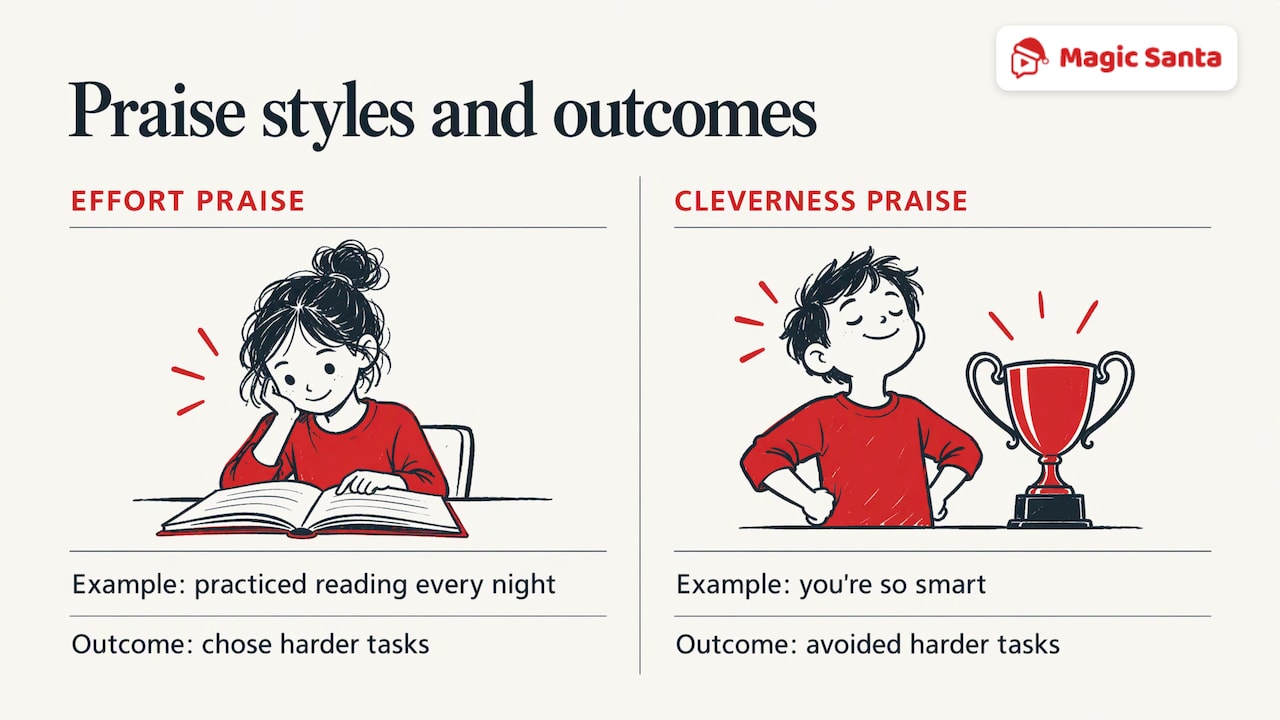
Second, praise the deed, not the person. Mueller and Dweck’s research on praise found children praised for effort picked harder tasks afterward, while children praised for being clever avoided them. So Santa should say “I heard you practiced your reading every night,” not “you’re so smart.”
The three-part Santa text
A short message that works for most ages has three parts, in about 25 words:
- Their name. Use what the family really calls them, nickname included.
- One specific thing Santa noticed. Learning to ride a bike, sharing a toy with a sibling, being brave at the dentist.
- A wish for the year ahead. Something forward-looking, not a threat or a test.
Here is an example for a six-year-old called Maya:
Maya, the elves told me you helped your little brother tie his shoes all by yourself. That is real Christmas spirit. Keep being kind, and I’ll see you soon!
That is 31 words, and it hits all three parts. Notice what it leaves out. Letters & Clues advises skipping threats, sibling comparisons and promises of a particular gift unless it’s really wrapped and waiting. Good rule. A child who is promised a pony and gets socks will remember the promise.
Write for the child’s age
The same guidance from KindFable holds up in practice: write for the child’s age, not yours.
| Age | What lands | Example of tone |
|---|---|---|
| 3 to 4 | Their name, a rhyme, a favorite animal or toy | “Hello Theo! The reindeer are dancing because they heard your name.” |
| 5 to 7 | A specific deed and a North Pole detail tied to what they love | “The elves are building a dinosaur train just like the one on your drawing.” |
| 8 to 10 | Being taken seriously, a real question, a little humor | “I read your list twice. Tell me more about why you picked the telescope.” |
For more phrasing ideas, our guide to Santa message ideas for kids goes deeper, and the piece on a personalized Christmas message in Santa’s voice shows how to keep the tone consistent.
Make it personal without oversharing
Personal does not mean you have to hand over your child’s life story. Before the Magic suggests a good approach: write a couple of lines yourself around a shared memory, like a fridge drawing, the family dog or a blanket fort, and use a nickname or a made-up town if you prefer. Then read the finished message as if you were a stranger and strip out school names, routes and identifying images before it goes anywhere.
The point is that a message feels personal because it names a moment your child recognizes. It doesn’t need an address or a school.
A small physical touch can back up the story. If Santa’s text mentions that the elves decorated something for your home, a little Christmas arrangement on bark on the mantel can become the proof your child finds the next morning.
How Santa chat works on WhatsApp
Magic Santa’s chat is two-way. Your child writes to Santa on WhatsApp, and he texts back, sends voice notes and remembers what the child told him earlier. He replies in the language your child writes in, which is a real help for bilingual families and for grandparents who want the child to answer in Spanish, Polish or Portuguese. Parents can see how it works on the Chat with Santa page.
The price is a one-time $9, not a subscription. Some chat and call usage is free, so you can see how your child reacts before buying more.
Set it up in five steps
- Pick the moment. After dinner, or a calm weekend afternoon. A child who is tired or hungry will not savor it.
- Decide whose phone. The conversation happens on the device you hand over. Sit next to your child for younger ages.
- Prepare two or three details. Pet’s name, a recent achievement, the wish on their list. Santa works best when he can build on what the child says.
- Let the child lead. Ask them to tell Santa something they’re proud of this year. Don’t prompt every line.
- Save the best bits. Screenshot the funniest exchange for the family group chat, and keep voice notes for later.
Why most Santa texts land on a parent’s phone
Before you plan a surprise, check who owns the phone. Pew Research found 23% of US kids 12 and under have their own smartphone: 8% of those under 5, 12% of ages 5 to 7, about three in ten of ages 8 to 10 and about six in ten of ages 11 and 12. In the same survey, 68% of parents said kids should be at least 12 before owning one.
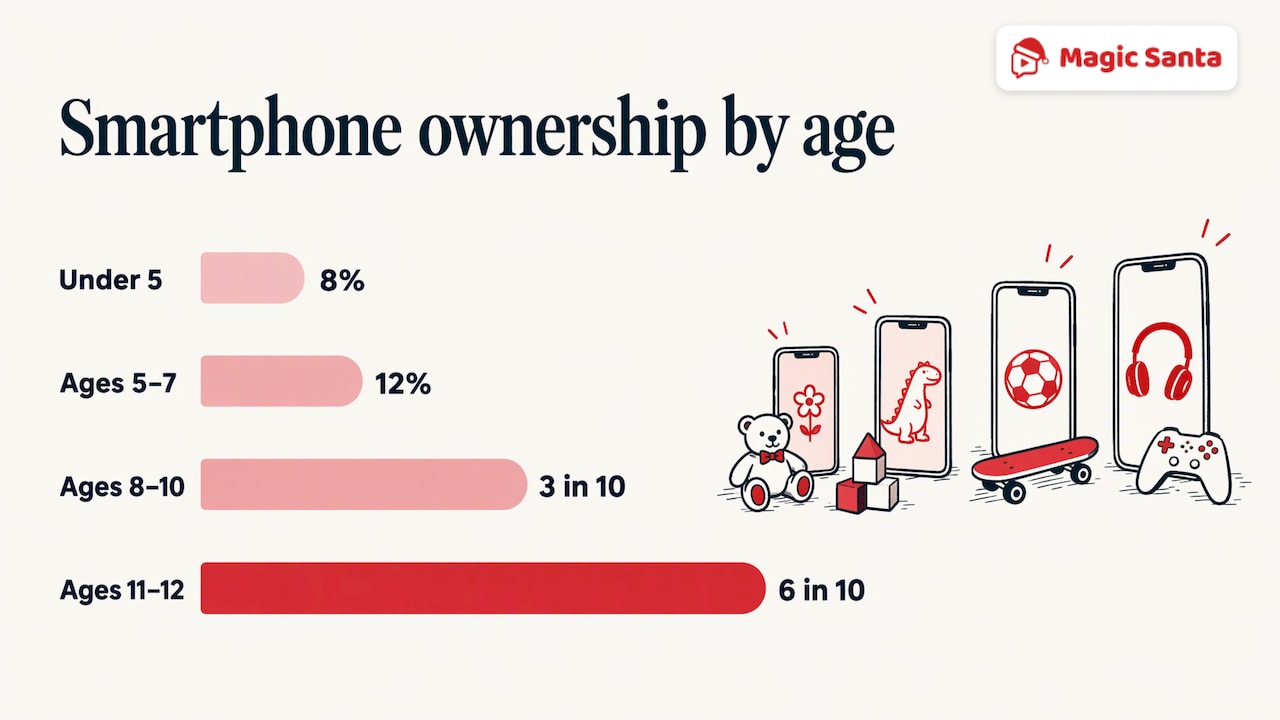
For the 3-to-10 crowd, that means the Santa text almost always arrives on a parent’s, grandparent’s or relative’s device. That’s useful. You are right there for the reaction, and you control when and where it happens.
Privacy: what to check before you sign a child up
A Santa text asks for a child’s name, often a phone number and sometimes photos or a voice. In the US, that matters. The FTC’s amended COPPA Rule, published April 22, 2025, requires operators of child-directed services to get verifiable parental consent before collecting personal information from children under 13. It also adds mobile phone numbers to the contact information it covers. Most regulated entities had until April 22, 2026 to comply.
The rule’s text defines personal information broadly: a telephone number, a photo, video or audio file with a child’s image or voice, and location precise enough to identify a street and town. Keep that list in mind when any service asks for something.
A practical five-question check:
- Whose phone number is being entered, yours or your child’s?
- Does the service need a photo, a voice recording or a location, and what for?
- Is the purchase made by an adult, with no account for the child?
- Will your child’s name and details be used only to personalize the message?
- Can you review what is sent before the child sees it?
With Magic Santa, the buyer is the parent or gift-giver, and for videos parents can read and edit the script before Santa records it. For calls, no account is needed. You decide what details go in.
One more point from CyberSafeKids’ 2024 to 2025 research in Ireland: a child left alone with any smart device is vulnerable to risk and harm. Hand the phone over for the Santa moment, then take it back.
Add a video so the reaction becomes a keepsake
A text vanishes into a scroll. A video stays. The Magic Santa video is a personalized film of two minutes or more in which Santa speaks directly to your child. He uses their name, mentions their age, celebrates their achievements this year and talks about their Christmas wishes. He can also show your own family photos and videos on his TV, narrating each one.
The feature families remember most is the Magic Reaction Cam. While your child watches, the device camera films their face. Magic Santa then combines both into one vertical video: Santa full screen, your child’s reaction in a picture-in-picture window. You can download it, keep it in your account or send it to grandparents and friends. Each film is a one-time $7, delivered in 1080p with no watermark.
For tips on the format, see our guide to a Santa surprise video and what makes a personalized Christmas video believable.
Sharing the reaction respectfully
Grandparents love a reaction clip. A few habits keep it comfortable for everyone:
- Ask your child if they want to show it to the family. Older kids at 9 or 10 can feel self-conscious.
- Send it to a family group chat rather than posting publicly.
- Check the background for school logos, street signs or a house number before you share.
- Keep the original file in your own account so you control where it goes.
For grandparents and far-away relatives
If you live far from your grandchild, a Santa text is a way to be in the room. You can buy the video or chat and let the parents set up the moment, then watch the reaction clip arrive in the family chat. Because Santa replies in the language the child writes in, a grandchild growing up in a different language from yours still gets a conversation that makes sense.
Gift givers buying for a niece, nephew or godchild can do the same. The parent is the person to ask for the child’s name, age, a recent achievement and the wish. That’s all the personalization you need.
Add a live call for the big night
Some children want to hear Santa’s voice. Your child can call Santa on +1 (845) 327-2682 and he answers in real time, greeting them by name. No account is needed to call, and the first messages and minutes are free. More minutes come with the $9 Talk to Santa purchase. Our guide to the Santa hotline for kids explains how to prepare, and the one on a Santa voice message covers recorded options.
A good order for the season: a chat in early December to build the story, a video on a quiet evening, and a call on Christmas Eve when the excitement peaks.
Where Magic Santa fits
If you want your child to get a text that responds, our Chat with Santa is the place to start. Santa remembers what your child says, answers by text and voice note and replies in your child’s language.

Want a keepsake as well? The personalized Santa video with the Reaction Cam is $7, and the live call is $9. Everything is a one-time purchase, with no subscription. You can see all three on the Magic Santa home page.
Other kinds of Santa texts
You’ll see a few other types around the holidays. Some seasonal services send scheduled messages on a calendar, a few weekly through December. There are free lines, such as a Santa hotline that texts you instructions to replay a message, and a number kids can text to send Santa their list and get an automatic reply. Those are fine for a quick hello. A conversation that knows your child’s name, age and news is a different thing, and it is the reason families come to us.